30 Sep Three Journeys notes
Three Journeys programme notes:
Simon-Mary Vincent – Shinkansen for 2 channel playback (2000)
“Shinkansen should take its place alongside Herbert Distel’s radiophonic classic Die Reise (1988) in a relatively small but inspiring genre of electroacoustic rail fantasias.”
Julian Cowley, The Wire
‘Shinkansen’ is an exploration of sounds recorded by the me in the course of a 3-week visit to Japan in the summer of 1998.
Visits to many of the country’s varied landscapes and cityscapes – ranging from more rural, family environments on the island of Kyushu through to Osaka, Kyoto, and the capital city Tokyo itself – were punctuated by travel on the famous Shinkansen trains, something which this composition reflects in the way it moves between ‘scenes’.
Many of these sounds are presented untreated as ‘sonic postcards’, most prominently in the cases of an amusement park in Osaka and the chant of a buddhist Monk recorded, with permission, at the home of a family in Saga during the Obon Festival season.
Other sounds have been treated extensively and serve to convey both the idea of travel between locations and the very notion of a Shinkansen train itself, notably at the beginning and conclusion of the work.
Shinkansen (2000)
Electroacoustic Music for 2-channel Playback.
Duration: 16’10”
Simon-Mary Vincent ( 2000)
John Stead – Toward a still point for 8 channel diffusion ( 2025 )
Duration: 30′ 00″
I hope the listener may find a series of comments that travelled with me during the composition of the work, preceding a brief structural narrative, useful:
Olivier Messiaen: “… invisible realities are more present than visible ones”.
Michael Tippett: ” … music is the interior flow of time.”
St. Augustine: There is no present – because it is instantly past. The mind is constantly shifting toward immediacy – towards the future or the past with such rapidity that the soul is forever distended in all directions without centre. To have any inking of a centre, concentration is necessary.
Stephen Batchelor: ” … sitting on a cushion for 10,000 hours doesn’t entitle you to any kind of insight or enlightenment. We have to be open to the fact that we may not achieve anything that corresponds to our preconceived ideas of what the goal of practice may be …”.
The work begins with an accumulation of harmonic fragments that are floating in the space around the listener accompanied, as throughout the whole piece, by bell sounds in all directions, differing registers and in various spaces.
After 2.5 minutes a rhythmic leitmotiv appears then dissolves into the spectral laminas which occupy the sound space around the listener.
Throughout the work this leitmotiv emerges and dissolves, each time slower and more fragmented.
The bells continue to sound and by 12.00 minutes, begin to become closer, clearer, deeper and slower. As the whole ‘corpus sonorum’ slows and modulates toward lower registers, the harmonic environment becomes thinner and more transparent, ushering in echoes of the original harmonic sounds that accumulated at the beginning, and the leitmotiv, now accompanied by very high bell harmonics …
This music continues to the edge of silence until the last section, which offers up the paradox of absence and presence – observed and observer …
Toward a still point : mp3 medium quality sound clip:
© John Stead. September 2025.
John Stead – Bardo Visions for 8 channel playback (2018 – 20)
Dedicated to the memory of Pierre Henry and Jonathan Dean Harvey: pioneers and composers of musique concrete and electro-acoustic music.
The correct title of the so-called Tibetan Book of the Dead is Liberation through Hearing between Death and Rebirth (Bar do thos grol). The recitation to dying and dead human beings is considered to be a powerful way to assist them in facing death and securing a better reincarnation by controlling the dangerous emotions that are encountered in the process (often represented as demons).
The ritual text is illustrated with iconography of all the peaceful and wrathful deities that are evoked in the course of its recitation – the content of the text is efficacious but also the perception of the chanting sound and the attendant ritual music can reach the consciousness at a deeper level.
Bardo Visions doesn’t attempt to follow the order of specific events or ‘appearances’ as laid out in the Tibetan Book of the Dead, but the framework of the of the sequence remains thus:
Chikhai bardo: the cessation of the external and internal breath …
Chönyi bardo: which is the fifth bardo of the luminosity of the true nature – the dawning of the 42 peaceful and 58 wrathful knowledge holding deities, …
Sidpa bardo … of transmigration … and becoming …
… atmospheres, apprehensions and encounters with the 100 deities of the bardo, are played out via sound objects and environments created through electronic transformation of everyday sounds comprising the five sacred elements of : earth, water, fire, air and space as well as instruments including the dung chen, which opens the work – the iconic Tibetan horn, up to 12 ft long, used in ceremonies and to herald important events and rituals.
The processes of sound transformation in this piece act as metaphors for the journey from the known to the unknown and the natures of the deities that are apprehended. In the Chönyi bardo, the deities are aspects of ourselves presented in strange, powerful, and often frightening forms – our senses stripped of their physical filters after death.
The sections are:
Chikhai bardo – the fourth bardo:
… acclamation – ‘external breath’ … opens with a slow powerful fanfare on the dung chen that ushers the listener into the liminal state of the bardo …
… then … soufflé continu – ‘internal breath’ in a landscape of ebb and flow …
… slow breath-like phrasing of sounds recede into large quiet and deep spaces where sound objects make their appearances as the phrasing of sounds slows and lengthens …
Chönyi bardo – the fifth bardo:
… toward ritual … apprehensions and appearances of the 100 deities …
…some sounds appear recognisable but transform into hallucinations and unknown sound-colours … increasingly powerful descending vortexes lead to a slow and complex polyrhythmic ritual comprising massive and powerful sound objects that define the sound-space.
… transformations of sound-object form and colour are further articulated through space creating a powerful mandala of all the deities – a sudden slowing and a just perceptible pause before:
Sidpa bardo – the sixth bardo:
‘Katchikatchi les etoiles, faites-les sauter … Katchikatchi les atomes, faites-les danser.’*
… some notes and influences:
This section begins quietly drawing on the sound material heard in the Chönyi bardo and deals with the preparation for re-birth …
* the subscript comes from ‘Harawi – chant d’amour et de mort” for soprano and piano by Olivier Messiaen. The text is surrealistic and evokes Peruvian folkloristic images and onomatopoeic texts: ‘Katchikatchi the stars, let them leap … katchikatchi the atoms, let them dance’ … katchikatchi means grasshopper in Peruvian – the text evokes and image of the lovers re-uniting as atoms in the cosmos – dancing like grasshoppers …
… the atmosphere is calmer and slower beginning with a slow chorale. The aggregation of sounds that are played backwards and forwards and at differing speeds, mostly as dualities, repeated phrases and mirroring at differing speeds and registers, gradually become more intertwined and convoluted, building to complex rhythmic sound textures. These textures eventually become less dense and fragmented … finally the sound is that of leaping and dancing sub-atomic particles on the horizon of a new reality …
John Stead 2021
Duration 51′ 30″
( EAE would like to thank Ben, Rachel and all the staff at Hull Minster for making this concert possible. )
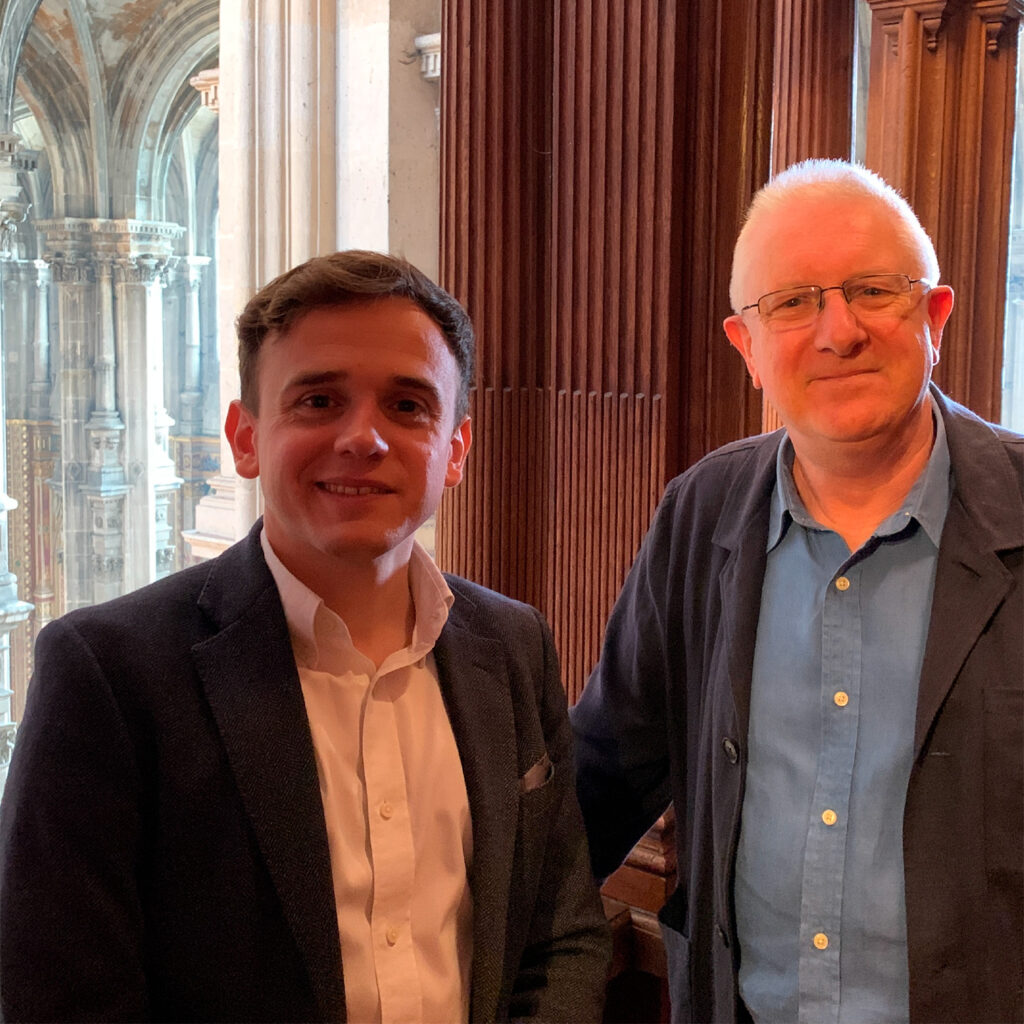
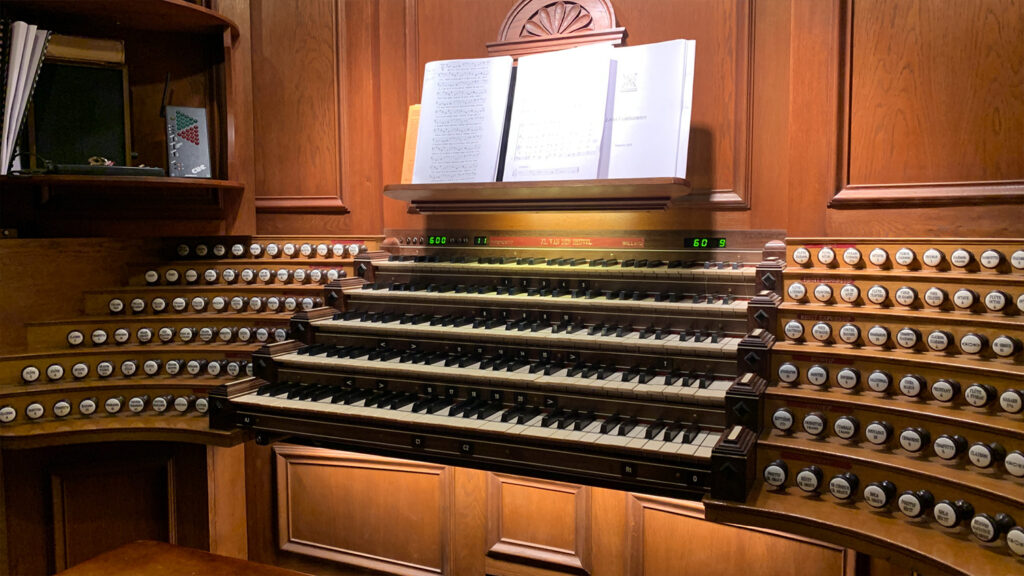
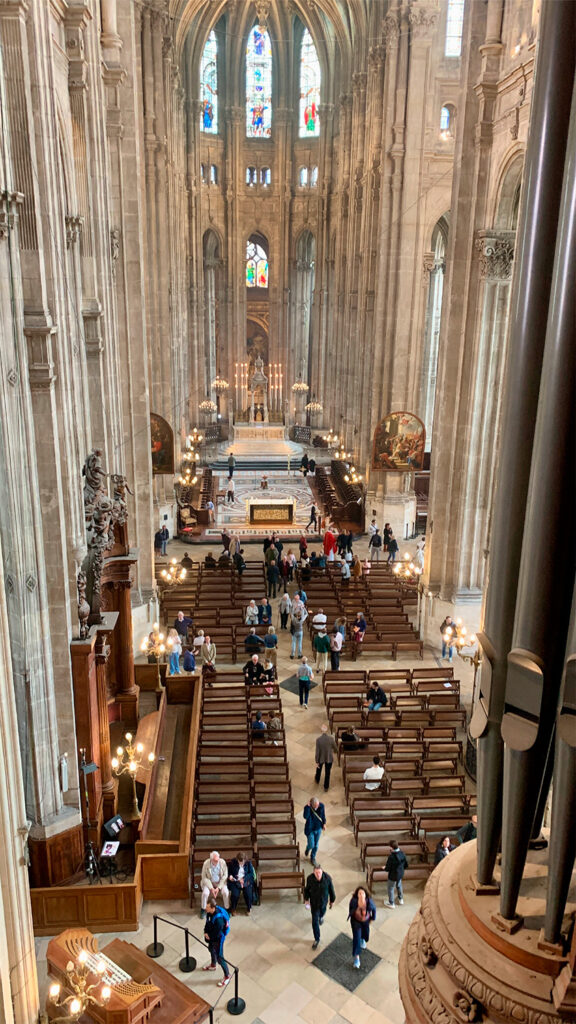
My association with St. Eustache goes back over 50 years when I was introduced to the then titulaire organist, teacher and composer Jean Guillou by the French architect Manu de Maurepas. Many years later in 2015, we met at his last performance of his Alice au pays de l’orgue. This year I had the honour and privilege of being invited up to the tribune at St. Eustache by the present titulaire organist Thomas Ospital.
The Grand organ is about to undergo a very big upgrade and refurbishment, when the orgue de choeur is to be rebuilt and performable from a new Grand organ console.
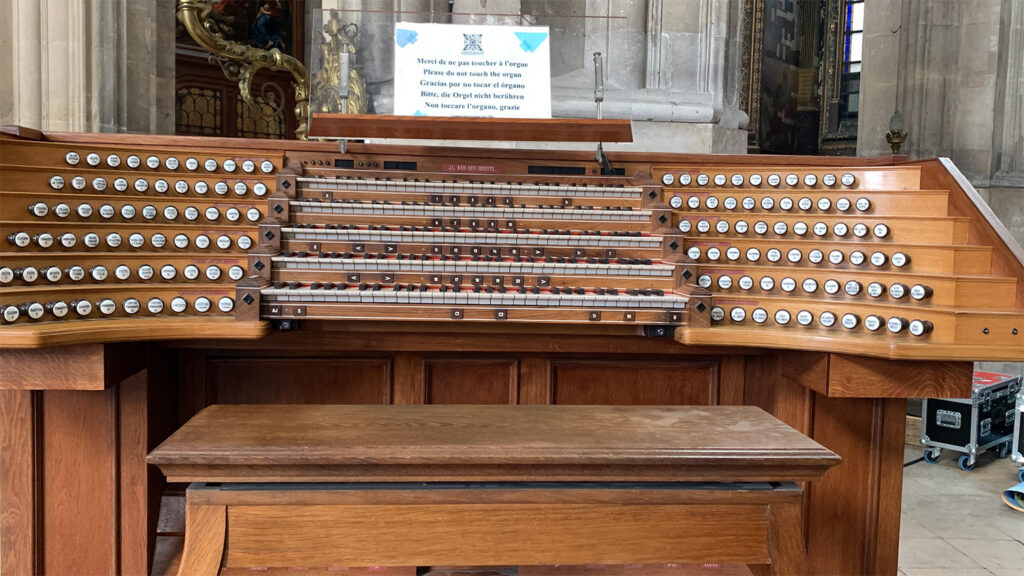
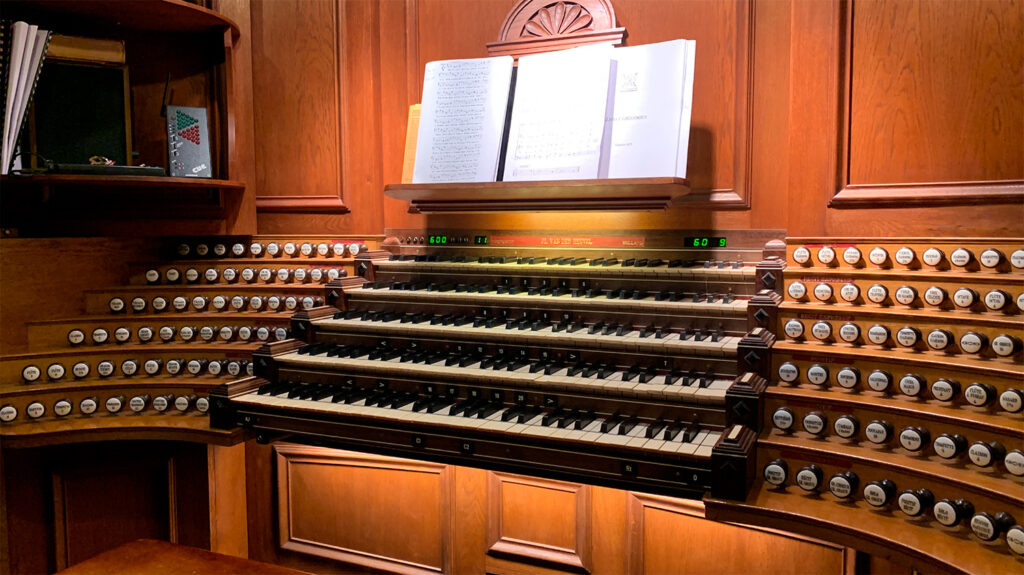
The 8000 pipe organ at St. Eustache now has an association dedicated to obtaining funds for this refurbishment, headed by Philippe de Carne and supported by Paris City Council. The organ is one of three major organs in Paris – the others being the Cavaille-Coll organ at St. Sulpice and the extended Cavaile-Coll organ at Notre Dame. The St. Eustache organ was completely rebuilt in 1989 ,under the direction of the then titulaire organist Jean Guillou, and whilst retaining some of the original pipework has many different sound colours, being built by the Dutch firm van Den Heuval.
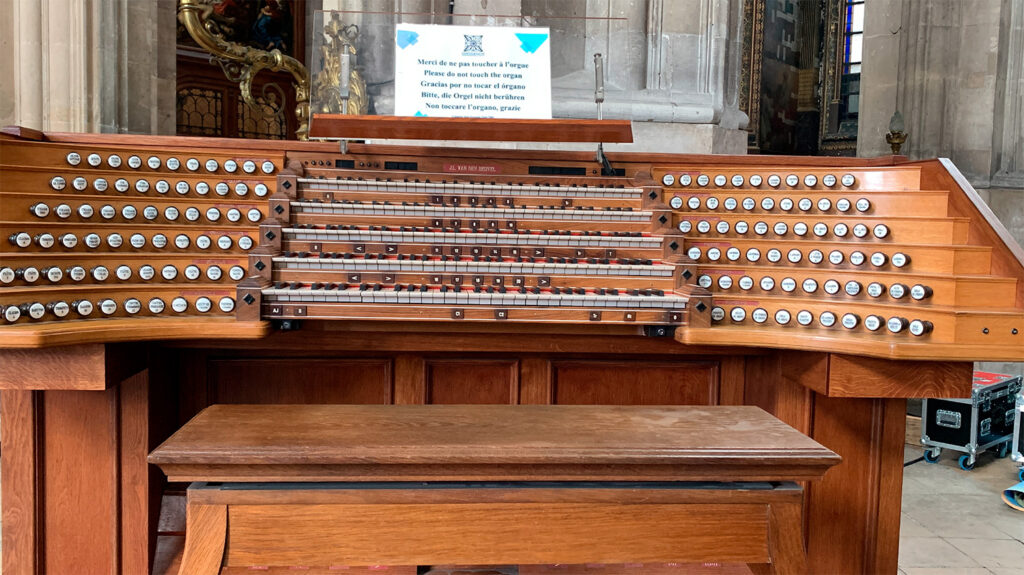
The photographs show a view the nave from the tribune, the present console at the tribune, the nave console and Thomas Ospital and myself.
If you wish to find out more about the organ click on the link here:
https://www.orguesainteustache.org/en
J.S. 2025.
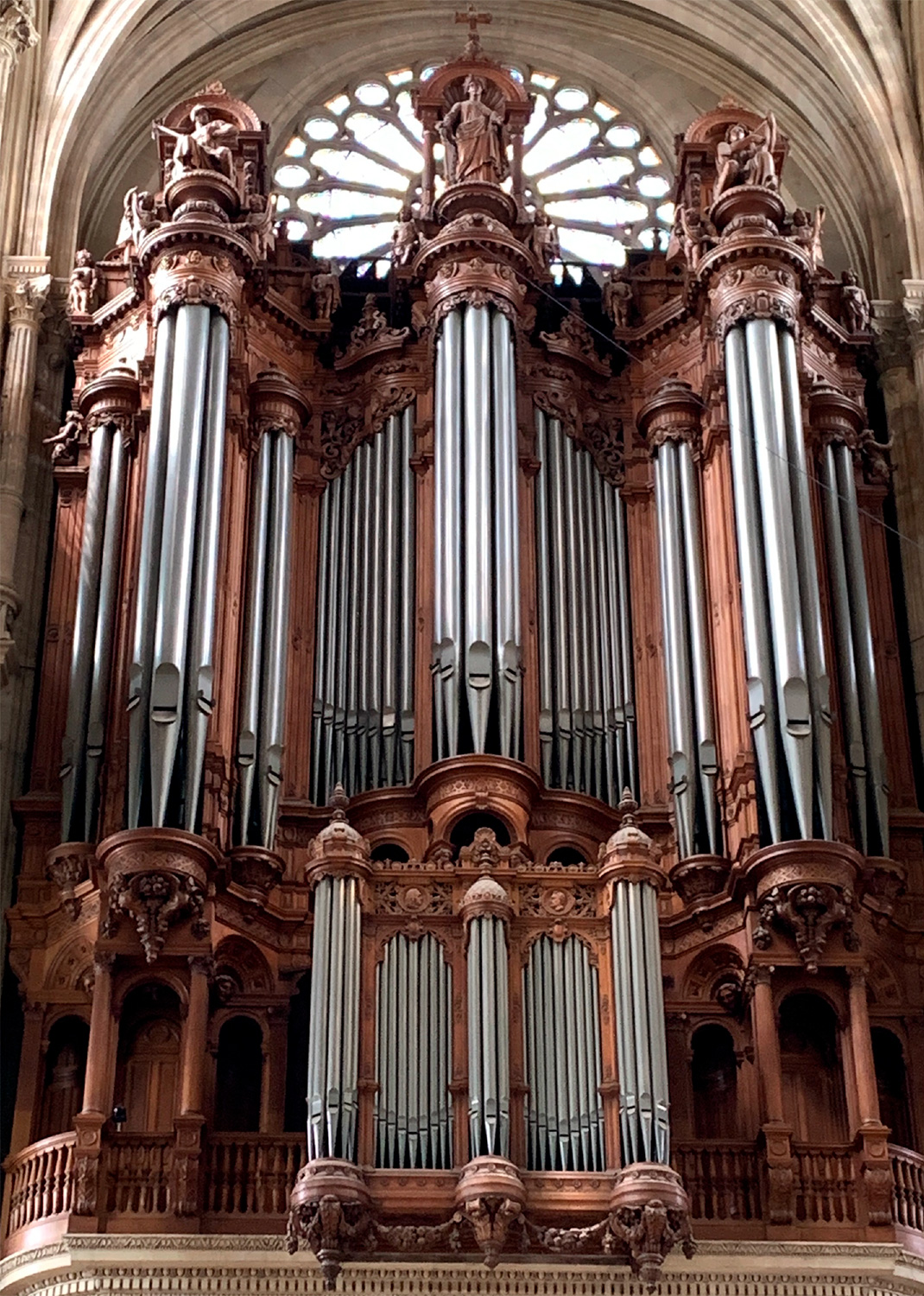
The Grand Organ at St. Eustache, Paris.